
Best PR Media Databases and Monitors for Modern Media Relations Teams (2026 Guide)
Media relations teams have never had more tools at their disposal and yet many still struggle with the same fundamental challenges: outdated journalist contacts, irrelevant media lists, and media monitoring reports that struggle to clearly demonstrate ROI, impact and reputational value.
Search for “best PR tools” or “best media database” and you’ll find countless listicles promising quick answers. In reality, the right tool depends on how your organisation practices media relations, where you operate, and what level of insight you need beyond basic distribution.
This guide looks at the best PR tools and media databases for modern media relations teams, with a particular focus on Ireland and the UK. Rather than ranking platforms by size or popularity, it evaluates them by use case, data quality, and strategic value.
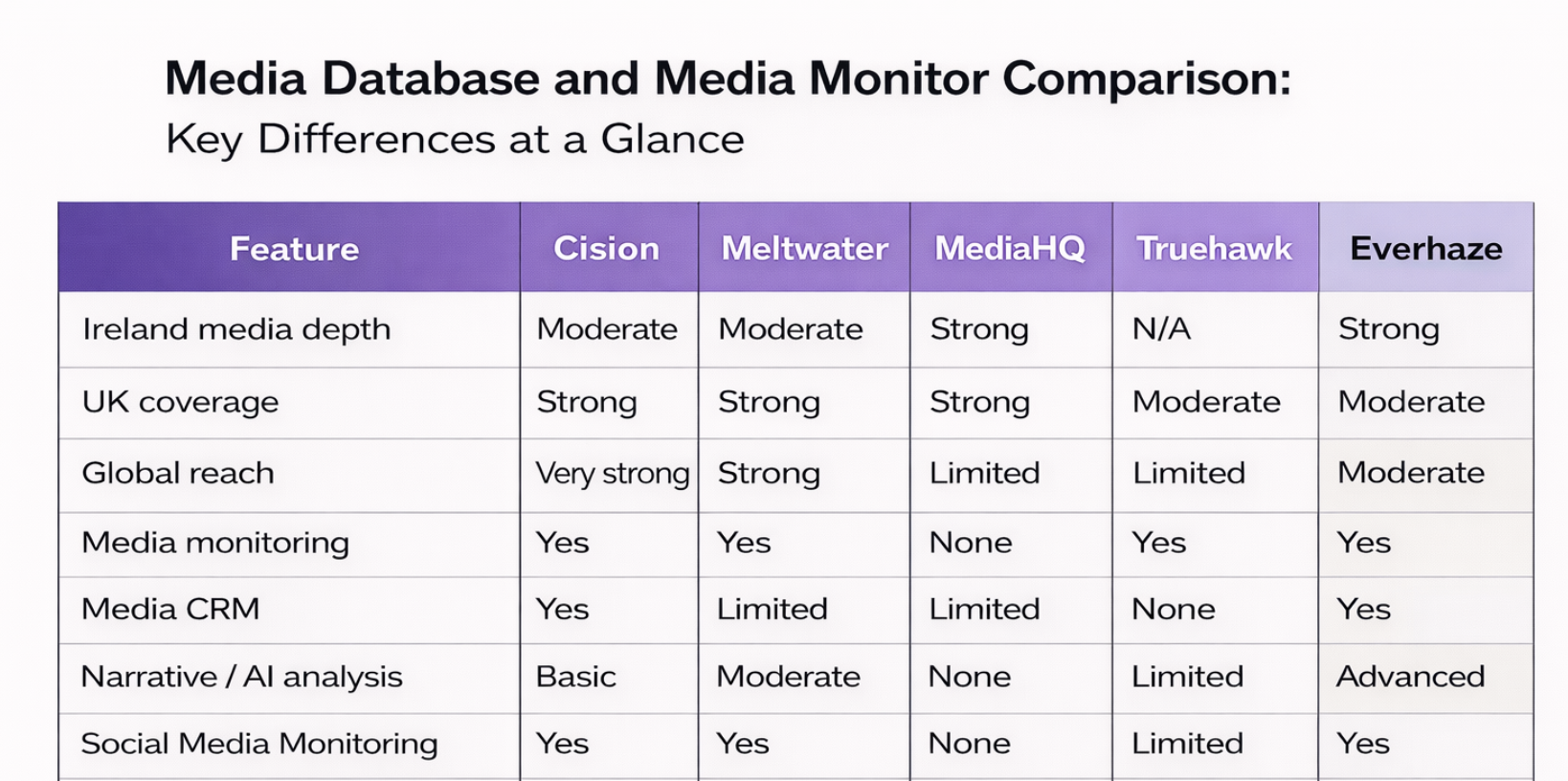
Based on the latest product information - 2026
What Are PR Tools (and Which Ones Matter for Media Relations)?
“PR tools” is a broad term that can mean very different things depending on context. For media relations specifically, the tools that matter most typically fall into five categories:
Media databases – journalist and outlet contact information
Press release distribution tools – targeted outreach to media lists
Media monitoring platforms – tracking coverage across print, online, radio and TV
Coverage Books and analytics tools – evaluating reach, tone, prominence and trends
Media CRM systems – managing relationships, outreach history and follow-ups
Some platforms bundle several of these together. However, media relations effectiveness still rises or falls on the quality and relevance of the underlying media database.
What Makes a Media Database “Good” in 2026?
A decade ago, media databases were often judged by how many contacts they contained. Today, that metric is largely meaningless. Modern communications teams increasingly assess databases using the following criteria:
Data accuracy and freshness
Journalists move beats, outlets and roles more frequently than ever. A media database must be actively maintained, with clear processes for verification and updates. Poor data quality damages credibility and wastes time.
Geographic depth and relevance
Global databases often underperform at local and regional level. For Irish organisations domestic and local coverage matters far more than international scale.
Journalist intent and specialism
Knowing who actually covers an issue is more valuable than knowing everyone at a publication. Beat accuracy, topic tagging and contextual notes now matter more than raw contact counts.
GDPR and consent handling
Media databases must operate within current data protection frameworks, including lawful bases for processing and clear opt-out mechanisms.
Integration with monitoring and reporting
The most useful databases are connected to coverage data, allowing teams to see not just who they contacted, but what coverage resulted and how narratives evolved.
Practical use of AI
AI adds value when applied to relevance, trend detection and narrative analysis not when used to automate mass outreach or generic pitching.
Best Media Databases by Use Case
Rather than ranking platforms from “best to worst”, the tools below are grouped by the types of organisations they typically suit best.
For large, global communications teams
Cision
Cision is one of the largest media databases globally, offering extensive international reach alongside integrated monitoring and distribution tools.
Strengths:
Global scale
Long-established platform
Broad feature set
Limitations:
Variable data quality at local level
High cost for teams that don’t require global reach
Less tailored to Ireland-specific media landscapes
Meltwater
Meltwater combines media monitoring, social listening and media database functionality within a single platform.
Strengths:
Strong monitoring and analytics capabilities
Broad international coverage
Large media database including secondary markets
Limitations:
Historically stronger in online and digital media than in licensed print and broadcast (radio and TV) monitoring
More limited penetration in local and regional Irish and UK media, particularly outside national outlets
Additional reporting requirements can be expensive
For PR professionals who need a centralised campaign platform with deep analytical capability
Everhaze
Everhaze is a centralised PR campaign platform designed for communications teams that need to plan, execute and evaluate media relations in one place.
Rather than treating media databases, press release distribution, social/media monitoring and reporting as separate tools, Everhaze brings them together into a single, integrated workflow. This allows PR professionals to move from campaign planning and outreach to coverage tracking and narrative analysis without losing context or data along the way.
Built for teams operating across Ireland and the UK, Everhaze places a strong emphasis on data quality, licensed media coverage and defensible analytics making it particularly well suited to reputation-sensitive organisations and senior PR decision-makers.
Strengths:
Centralised platform combining media database, distribution, monitoring, reporting and CRM
Licensed monitoring across online, print, radio and TV
Campaign-level analytics that connect outreach to outcomes
Narrative and issue analysis that shows how stories evolve over time
Strong Ireland and UK media coverage with local and regional depth
Good fit for agencies to manage specific clients and reporting
Considerations:
Not positioned as a global, multi-continent media database or media monitor
Designed for teams that want depth and insight rather than lightweight tools
Other media database and media monitoring options in the Irish market
Ireland has a small but established media database and media monitoring landscape, with several providers focused primarily on domestic coverage and media contact management.
MediaHQ
MediaHQ is a long-standing Irish media database provider, primarily focused on journalist contact information and press release distribution.
Typically suited to:
Small to mid-sized in-house teams
Organisations focused on outbound media lists and distribution
Considerations:
No integration with media monitoring or social media monitoring
Truehawk
Truehawk is an Irish-based media monitoring provider, focused on tracking coverage across traditional media alongside social media monitoring.
The platform is designed to help teams monitor PR activity, measure coverage and track social conversation, with an emphasis on ease of use and operational reporting rather than media list building or outreach management.
Typically suited to:
Teams that need Irish media and social monitoring in one tool
Organisations focused on tracking coverage and online conversation
In-house teams looking for a practical, monitoring-led solution
Considerations:
Does not provide a media database or journalist contact management
Media insight and analysis capabilities are more operational than strategic
Limited depth in narrative or issue trend analysis over time
Not designed as a centralised PR campaign or outreach platform
The Best PR Tools Are No Longer Standalone
Modern media relations rarely succeed using a single tool in isolation. Media databases, distribution, monitoring and reporting increasingly function as one connected system.
Effective PR teams now expect to:
Build targeted, relevant media lists
Track coverage in near real time
Understand which narratives are gaining traction
Report impact in a way that stands up to scrutiny
As a result, many organisations are moving away from standalone databases toward integrated media intelligence platforms that combine contacts, coverage and insight in one workflow.
How to Choose the Right PR Tool for Your Team
The most important question when selecting a PR tool is “What provider reflects how we actually want to work?”
Different organisations require different strengths:
Public-sector and semi-state organisations typically need high data accuracy, regulatory compliance and reporting that can stand up to scrutiny but trade off usability for the privilege.
Agencies often prioritise the clients needs alongside strong CRM functionality but the ability to manage multiple clients and campaigns in parallel is therefore lacking.
Large multinationals may value global reach, consistency and standardised workflows over local depth or nuance but they miss out on the full picture leaving them with a large information gap.
Ultimately, choosing the right platform means matching a tool’s strengths to organisational reality rather than paying for features that look impressive but rarely get used.
Final thought
Media relations has moved beyond mass distribution and simple coverage counts. The best PR tools today are those that help teams understand who matters, what’s being said, how narratives are shifting over time and make it easy to do all of those things.